




en
en v
Phone
Cart0 Tickets
Total: 0€
Account
Calendar
Search
Menu
X

The Valkyrie

VenueFelsenreitschule
CalendarSat 20 Mar 2027 - Mon 29 Mar 2027
Synopsis/Details

Synopsis


Act I

Exhausted from fleeing his pursuers through a storm, Siegmund bursts into the door of a strange house and collapses. Sieglinde finds him slumped beside the hearth, and the two feel an immediate attraction toward each other. Their discussion is interrupted by Sieglinde's husband, Hunding, who asks Siegmund who he is. Siegmund, saying his name is "Wehwalt" (Woeful), describes his life of adversity, the death of his mother and the loss of his sister. Eventually everyone realises that Hunding is in fact kin to Siegmund's enemies. In observance of the law of hospitality, the host will not take Siegmund's life right away, but states that when morning comes, the two must meet in mortal combat. Left by himself, Siegmund addresses his father, Wälse – who is really Wotan, the ruler of the gods in human form – to give him the sword that he once promised him. Sieglinde returns and tells him that she has given Hunding a sleeping draught, and the two can speak without fear. She relates the story of how she became Hunding's wife, and of the one-eyed stranger who thrust a sword into the stump of the ash tree at the centre of the house, and how nobody has ever been able to pry it out. Sieglinde also reveals to the visitor how unhappy she is. Siegmund embraces her and promises to free her from her forced marriage with Hunding. As moonlight floods into the room, Siegmund compares the feelings welling up inside them to the union of love and springtime. Sieglinde, addressing Siegmund as "Spring", asks if his father truly is "Wolfe", as he had claimed earlier. When Siegmund reveals that his father is really Wälse, Sieglinde recognises that the man she is facing is her twin brother. Siegmund draws the sword from the tree trunk and declares Sieglinde to be his bride. The two Wälsungen are united in happiness.


Act II

On a high mountain ridge, Wotan is speaking with his favourite warrior daughter, the Valkyrie Brünnhilde. He asks her to help his mortal son, Siegmund, in his battle with Hunding. Brünnhilde is about to happily depart to accomplish her mission when Fricka, Wotan's wife and the goddess of marriage and the hearth, arrives and insists that the adulterous – not to mention incestuous – siblings be punished, meaning that Wotan must protect Hunding's marriage rights against Siegmund. She pays no heed to Wotan's argument that Siegmund might be able to save the gods by regaining the Nibelung Alberich's all-powerful ring from Fafner, the giant who has changed himself into a dragon. Wotan realises that he has fallen into his own trap: if he does not enforce the law, then his own power will also vanish. He gives in and accepts his wife's demands. After Fricka's departure, the chief god, angry and feeling his own impotence, tells the returning Brünnhilde the story of the theft of the Rheingold, and how Alberich placed a curse on the ring he had made from the gold. Brünnhilde listens to her father in astonishment as he relates the story of the plan, now in ashes, he had devised to save the gods, and how she must now fight on Hunding's side in the deadly encounter. Meanwhile, in the forest, Siegmund is attempting to calm Sieglinde, who has nearly lost her mind from fear and shame, and watches over her when she finally falls asleep. Brünnhilde appears to Siegmund as if in a vision and informs him that he will soon die and go to Valhalla. Siegmund replies that he will not go without Sieglinde, and threatens to kill both himself and his love if his sword is certain to have no power against Hunding. Moved by his tenacity, Brünnhilde elects to be guided by her father's innermost desires and – despite the god's decision and express order to the contrary – aid Siegmund, who upon hearing Hunding approaching, bids farewell to Sieglinde. As the two men do battle, Siegmund – thanks to Brünnhilde's protective shield – is about to triumph when Wotan appears and shatters Siegmund's sword, Notung, into fragments with his spear. The now weaponless lad is quickly slain by Hunding, while Brünnhilde, fearing her father's vengeance, flees clutching both Sieglinde and the splintered shards of Notung to her. With a single gesture, Wotan kills Hunding as he stands triumphantly over Siegmund's body, and then heads off after Brünnhilde in order to punish his favourite child for her grave disobedience.


Act III

Brünnhilde's eight warrior sisters, the Valkyries, gather on a mountaintop: this is where they gather on their way to Valhalla, the place where they take fallen heroes in order for them to guard the home of the gods for all eternity. They are surprised to see Brünnhilde arrive on her horse bearing not a hero, but a woman: Sieglinde. When her sisters learn that she is fleeing from Wotan's wrath, they do not dare to hide her. Despairing and powerless, Sieglinde is resigned to die until Brünnhilde informs her that she is carrying Siegmund's child underneath her heart. Sieglinde then asks the Valkyries for assistance and guidance, takes the pieces of Notung from Brünnhilde and, thanking the brave Valkyrie for her aid, sets off for what Brünnhilde's sisters have told her is the one place safe from Wotan: the forest guarded by Fafner. The ruler of the gods arrives, casts Brünnhilde out of the ranks of the Valkyries and announces his intention to turn her into a mortal woman as punishment. Brünnhilde's sisters rush to her defence, but he warns them that they will share her same fate if they offer her their protection. Left alone with her father, Brünnhilde argues that she was actually following Wotan's true will when she defied him. Unswayed, her father will not alter the punishment: Brünnhilde will lie in a deep sleep on the mountaintop and will belong to the first man who happens to find her. The girl asks her father to surround her with a wall of fire that only the bravest hero would dare to cross. Both of them hope and feel that this hero will be the child soon to be born to Sieglinde. Wotan bids a sad farewell to his dearest child, and with a paternal kiss sends Brünnhilde into a deep sleep and mortal existence before summoning Loge, the god of fire, to encircle the high crag, Brünnhilde's resting place. As the flames rise, Wotan casts an enchantment on the fire that will deter anyone who fears the power of Wotan's spear from entering.

Cast

Cast

Conductor: KIRILL PETRENKO
Production / Set / Costumes: KIRILL SEREBRENNIKOV
Co-Set Design: OLGA PAVLUK
Co-Costume Design: SHALVA NIKVASHVILLI
Assistance Costumes: ELIZAVETA DOROSHENKOVA
Light Design: SERGEY KUCHER
Video: YURII KARIKH
Dramaturgy: DANIIL ORLOV
Choreography: EVGENY KULAGIN
Sculptures: RECYCLE GROUP

Siegmund: JAMEZ MCCORKLE
Wotan: CHRISTOPHER MALTMAN
Hunding: BRINDLEY SHERRATT
Sieglinde: CHRISTINA NILSSON
Brünnhilde: LISE DAVIDSEN
Fricka: CATRIONA MORISON
Helmwige: TESSA MCQUEEN
Gerhilde: AVIVA FORTUNATA
Ortlinde: HEDVIG HAUGERUD
Waltraute: NATALIE LEWIS
Siegrune: XENIA PUSKARZ THOMAS
Roßweiße: FLEURANNE BROCKWAY
Grimgerde: AYTAJ SHIKHALIZADA
Schwertleite: EKATERINA CHAYKA-RUBINSTEIN

Venue
Felsenreitschule

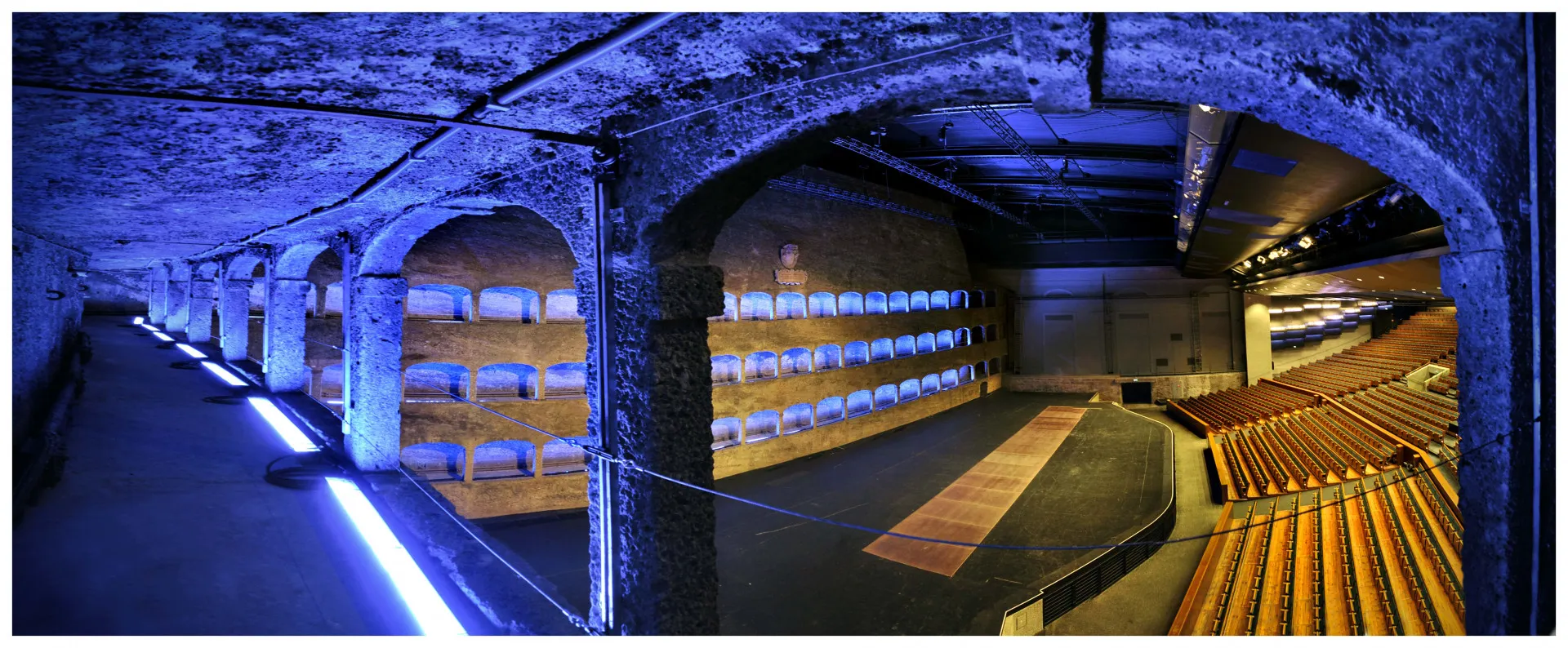
It was Max Reinhardt who suggested that the Winter Riding School should be converted, and it was also his idea to transform the Summer Riding School (Felsenreitschule) into a theatre. During the first half of the 17th century conglomerate rock was quarried here for the building of the cathedral. In 1693, during the reign of Prince-Archbishop Johann Ernst Thun, according to plans by the Baroque master architect Johann Bernhard Fischer von Erlach, three tiers of 96 arcades were hewn into the walls of the disused quarry so that from here people could watch equestrian displays and animal baiting events.


In 1926, when Max Reinhardt first attempted to use the Felsenreitschule to stage Goldoni’s Servant of Two Masters for the Salzburg Festival, the ambience was ideal for the “realistic” character comedy in the style of popular theatre: the action took place on a so-called Pawlatschenbühne, a small raised platform, the ground consisted of compressed earth and the audience sat on wooden benches. In 1933 Clemens Holzmeister built a remarkable set for the production of Faust in the Felsenreitschule, the Faust Town which is still regarded as one of the most impressive transformations of this venue. The first opera production in the Felsenreitschule took place in 1948 when Herbert von Karajan conducted Gluck’sOrfeo ed Euridice.


From the end of the 1960s radical conversion and adaptation work took place, mainly according to plans by the “festival architect” Clemens Holzmeister. An understage area, an orchestral pit and a lighting bridge were installed, a weatherproof roll-back roof to offer protection against rain and cool summer evenings, and finally an auditorium with boxes and circles as well as a depot for scenery were created.

Jean-Pierre Ponnelle’s staging of Mozart’s Die Zauberflöte, which was presented here every summer from 1978 to 1986, achieved legendary status. The same is true of Shakespeare’s plays Julius Caesar, Coriolanus and Anthony and Cleopatra in the productions by Peter Stein and Deborah Warner (Coriolanus),which in the early 1990s were internationally acclaimed.


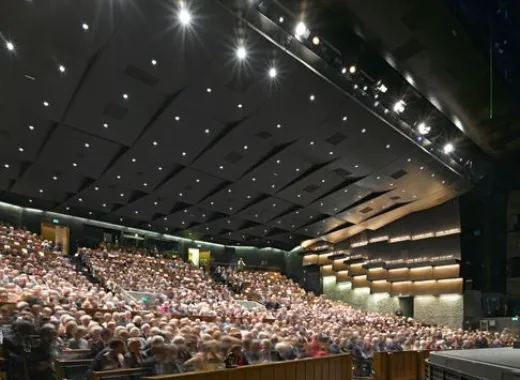
When the Haus für Mozart was built, the Felsenreitschule already received a new audience grandstand, which resulted in improved sightlines and acoustics for the audience.


Improvements are:

- A new roof construction with two fixed girders at the edges and three elements supported by five telescope cantilevers: the slightly inclined pitch roof consisting of three mobile segments resting on five telescope arms will be retractable and expandable within six minutes. Hanging points on the telescope cantilevers for stage technology (chain hoists), improved acoustical and heat protection and two lighting bridges will optimize the stage action.

-     New security technology including electrical installations, stage lighting, effect lighting and effect sound.

-     In addition, the interior expansion of the 3rd floor will be completed at that time, and the building shell of the newly constructed 4th floor under the roof of the Felsenreitschule will be made available to the Festival – this being the last instance in which new space can be created within the Festival District.

Accomodation

Buy now

Gift vouchers

Gift someone an unforgettable night at the opera.
Choose a gift coupon and let them pick the performance they love—music, drama, and world-class artistry, all in one elegant experience.
Opera Festivals in Europe, Official Programme and Tickets
Instagram
Payment
© 2026 RM EUROPA TICKET GmbH
Whatsapp